The front and the back legs should move parallel if you look from the back and from the front. The front legs must reach well out and the back legs move smoothly at the hips and the flexing well at the stifle and hock.
Thursday, 31 July 2014
The Movement Of The Bull Terrier
The movement stems from the long legs in front and the powerful thrust of and the drive of the back legs. The movement is best see from the side. When the dog move soundly the pads of both of the front feet and back will be clearly seen.
The front and the back legs should move parallel if you look from the back and from the front. The front legs must reach well out and the back legs move smoothly at the hips and the flexing well at the stifle and hock.
The front and the back legs should move parallel if you look from the back and from the front. The front legs must reach well out and the back legs move smoothly at the hips and the flexing well at the stifle and hock.

The Tail of the Bull Terrier
The tail of the Bull Terrier must be short and straight. The root of the tail is thick and tapering to a point. The tail is set low and carried horizontally. If the tail is bit higher it means that the hindquarters is weak. The dog's tail can tell in which mood he is. If the dog's tail is between it legs he is frightened. If the dog raise his tail in a curve above his body when becomes excited.
 |
| http://images.clipartof.com/small/21498-Clipart-Illustration-Of-An-Alert-Bull-Terrier-Dog-Holdings-Its-Tail-Out-And-Facing-Front-On-A-White-Background.jpg |
Monday, 28 July 2014
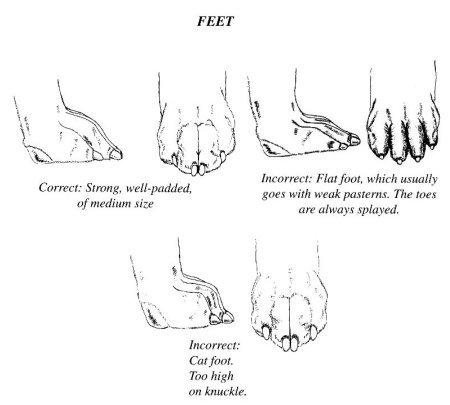
The Bull Terrier Feet
 |
| http://alfatauri.pl/zdjecia/wzorzec/feet.jpg |
The Bull Terriers possess is small but strong feet with the
toes close together, like those of a cat. The back feet is slightly smaller
than the forefeet. The toes are not flat but bent, and the dog walk on his toes
rather than on his pads. The pastern above the front paw must be strong and
straight so that it forms a straight line with the rest of the leg.
Thursday, 24 July 2014
The Hindquarters of a Bull Terrier
The Bull terrier’s power and propelling force lies in the
hind legs. Therefore they are muscular and strong. It is important that the
muscular attachment of the various bones is correct for the facilitate of
movement and ensure a proper stance. To have the correct angles between the
bones each must be the correct length.
The upper thigh as well as the second thigh should be well
developed and very muscular. Were the hock is joint with the second thigh and
the toe is short and strong. When the hock is turn inward when viewed from
behind are referred to as a ‘cow hock’ and spoil the look of the hindquarters. Bull
Terriers suffer from hip dysplasia, but slipping patella’s’ are quite common. The
patella is small and held in position by muscles and ligaments. Its function is
to keep the bones of the leg acting in unison. If a patella slips the knee-joint
will give towards the outside and waken the hind leg.
Wednesday, 4 June 2014
The Chest of the Bull Terrier
The chest must be well – developed and round enough to
provide sufficient space for the efficient functioning of the lungs. The chest
of the Bull Terrier is deep in the front and should comprise fifty per cent of
the Bull Terrier’s height from the ground to the withers. The chest curves
upwards to where the abdomen begins. As a simple guide: the chest should be
level with the dog’s elbows.
 |
| http://www.bulldazzledbullterriers.com/uploads/5/2/3/1/5231105/3008669.jpeg |
Monday, 2 June 2014
The Back Of The Bull Terrier
A Bull Terrier have a sort powerful back with a straight
top, that rises slightly from the rear of the loins to pass over the rump.
 |
| http://www.daxtonsfriends.com/wp-content/uploads/2014/02/English-Bull-Terrier-1.jpg |
Seen from above, the back should appear to be full, without any flattening along the sides. Seen from above, the hips should appear slightly narrower than the shoulders.
The Forequarters of a Bull Terrier
The Shoulders must be strong and muscular, but not loading. The
angel of the shoulder blade and the upper arm ought to be 90 degree. The shoulder
blades are wide and flat and held closely to the chest wall. They have very
pronounced backward slope of the front edge and from the bottom to the top
forming almost a right angle with upper arm. The breast bone of the Bull
Terrier should stand out slightly beyond the linkage of the shoulder blade and
upper arm. When the angel of the shoulder blade and upper arm is greater than
90 degree the shoulder will be too vertical. The length of the upper arm and shoulder
blade must be the same.
 |
| http://www.bulavardbullterriers.com/images/page_214.jpg |
If the upper arm is too short the result will be a vertical
shoulder. Any deviation from the correct angle or length of the bones will restrict
the dog length of stride. Well –
assembled forequarters are usually accompanied by good hindquarters.
Subscribe to:
Posts (Atom)